
Stretch Hooding for Bagged Products: Outdoor & Export Protection
Bagged products are some of the toughest loads to protect. Cement, fertilizer, seed, pet food, resin, salt — these loads settle, shift, and compress in ways boxed goods don’t. Add outdoor storage or a multi-week export journey, and the packaging around the pallet becomes the only thing standing between your product and moisture damage, UV degradation, and load failure.
That’s exactly the situation for which the environmental stretch hooding was built. Here’s why more producers of bagged goods are moving to stretch hood systems for pallets headed outdoors or overseas.
Why Bagged Loads Are Different
Unlike rigid cartons, bags don’t create a stable, squared-off pallet. They:
- Settle and shift in transit. Bag contents redistribute with vibration, loosening a wrap that was tight at the dock.
- Have no structure of their own. The film has to supply the load containment that the product can’t.
- Are often stored outside. Building materials, agricultural inputs, and bulk chemicals frequently sit in yards exposed to rain, sun, and dust before they ever ship.
- Travel far. Export loads face weeks of humidity swings, ocean-container condensation, and repeated handling.
Conventional stretch wrap leaves the top of the pallet open — a problem the moment a load sits in the rain. Shrink hooding covers the top but adds a heat step, which raises energy costs and introduces risk around some products. Stretch hooding closes that gap.
How Stretch Hooding Protects Bagged Products
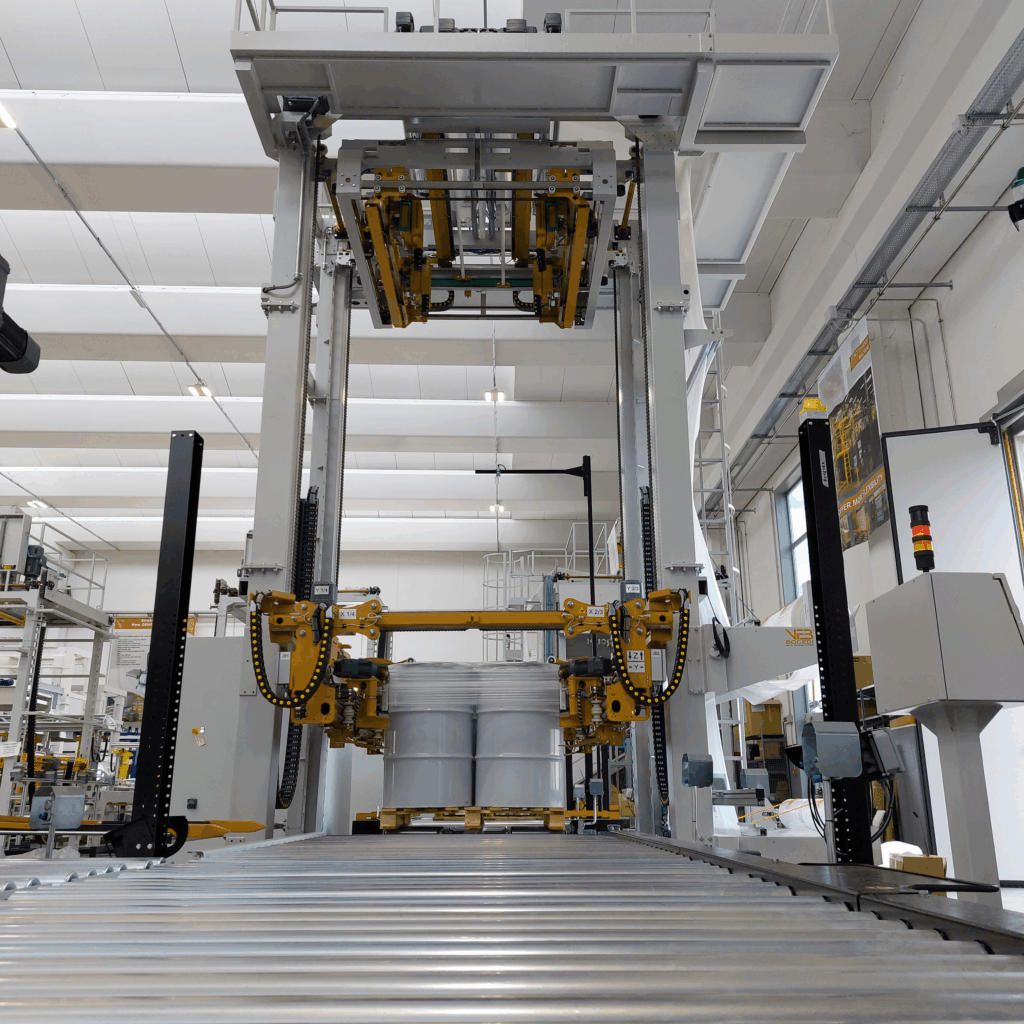
A stretch hooder applies a tubular film hood that is stretched open, pulled down over the load, and released — no heat required. The film’s elastic recovery grips the pallet from all sides.
Five-Sided, Weather-Resistant Coverage
The hood seals the top and all four sides of the load in a single layer of film, conforming to the shape of the pallet. For bagged products stored outdoors, that means protection against rain, dust, and UV exposure from the moment the pallet leaves the line — not just during transit.
Load Stability That Holds Through Settling
Because the film stretches and recovers around the load, it maintains tension even as bags settle. That vertical holding force is a key advantage for loads that shift slightly during transport — a common failure point for bagged goods secured with conventional wrap. Poorly secured palletized loads can see damage rates in the double digits, so containment isn’t a nice-to-have; it’s a direct cost line.
Export-Ready Durability
Stretch hood film is waterproof and tear-resistant, built to withstand repeated forklift handling, staging time, trailer vibration, and the humidity of ocean freight. One continuous hood also means no film tails or loose layers to snag during container loading.
No Heat, No Product Risk
Because stretch hooding skips the heat tunnel, there’s no thermal exposure to worry about for heat-sensitive contents — and no energy-hungry equipment adding to operating costs or facility strain.
Operational Benefits Beyond Protection
Protection is the headline, but stretch hooding also improves how the rest of the operation runs:
- Speed. Automated stretch hooders wrap significantly faster than conventional stretch wrappers, with high-throughput systems reaching hundreds of pallets per hour.
- Lower film and energy costs. Controlled stretching applies film efficiently, often using less material per pallet than wrapping or shrink hooding — with no heat tunnel on the utility bill.
- Scan-ready clarity. Clear stretch hood film keeps barcodes and bag printing visible, so warehouse teams can identify and scan products without cutting into the packaging.
- AGV compatibility. Hooding leaves the pallet feet free of film, which matters for facilities using automated guided vehicles or automated storage systems.
- A cleaner presentation. A smooth, tight hood gives bagged products a polished look at delivery — and the film can even serve as a branding surface.
Is Stretch Hooding Right for Your Bagged Product Line?
Stretch hooding tends to be the strongest fit when:
- Pallets are stored outdoors or in unconditioned space before shipping
- Loads travel long distances or move through export channels
- Your line runs at volumes where automation pays for itself
- You handle multiple pallet sizes or SKUs and need fast, repeatable changeovers
- Moisture, dust, or UV exposure has caused product damage or rework in the past
Shrink hooding still has a role for highly irregular loads that demand maximum film conformity — but for most bagged product operations, stretch hooding delivers stronger all-around protection at a lower operating cost.
Match the Right System to Your Line
Stretch hooders range from entry-level systems for moderate throughput to high-performance machines built for demanding, high-volume environments — with options that support multiple film sizes and automatic film selection for mixed pallet operations.
The right fit depends on your pallet dimensions, throughput targets, and the conditions your loads face after they leave the line. Talk to a packaging expert about your load profile, and get a recommendation matched to how your bagged products actually store and ship.