
Best Packaging Methods for Doors, Windows, and Cabinetry
When you’re shipping high-value products like doors, finished cabinetry, and window assemblies, packaging isn’t just a final step—it’s a critical safeguard for your margins. Even minor damage during transit can result in costly rework, rejected shipments, and strained customer relationships.
The challenge is that many traditional packaging methods simply aren’t designed to protect large, fragile, or high-gloss millwork. To truly prevent damage, manufacturers need a packaging approach that accounts for both surface protection and structural stability, making orbital wrappers the most effective solution for securing and protecting these products in transit.
Why Traditional Wrapping Methods Fall Short
Turntable-style stretch wrappers are common in many facilities, but they pose real risks when used with doors, windows, and cabinetry. These systems rotate the product vertically while applying film tension, which can create several issues:
- Glass-to-frame stress: Rotational forces can shift weight unevenly, putting pressure on glass panes and joints.
- Corner crushing: Film tension pulls inward at stress points, especially on sharp edges and corners.
- Surface damage: High-gloss finishes are vulnerable to abrasion without a proper protective layer.
For delicate, high-value products, these risks add up quickly, and so do the costs associated with damaged shipments.
Some manufacturers try to offset these risks with stabilizing accessories, like a top press or window and door clamp, that hold the product firmly in place before the wrap cycle begins. These tools can reduce shifting and add a layer of support, but they only solve part of the problem: the product still endures the same rotational forces once wrapping starts. For items where even minor movement can stress glass panes or joints, that’s often not enough.
The Advantage of Orbital Wrapping
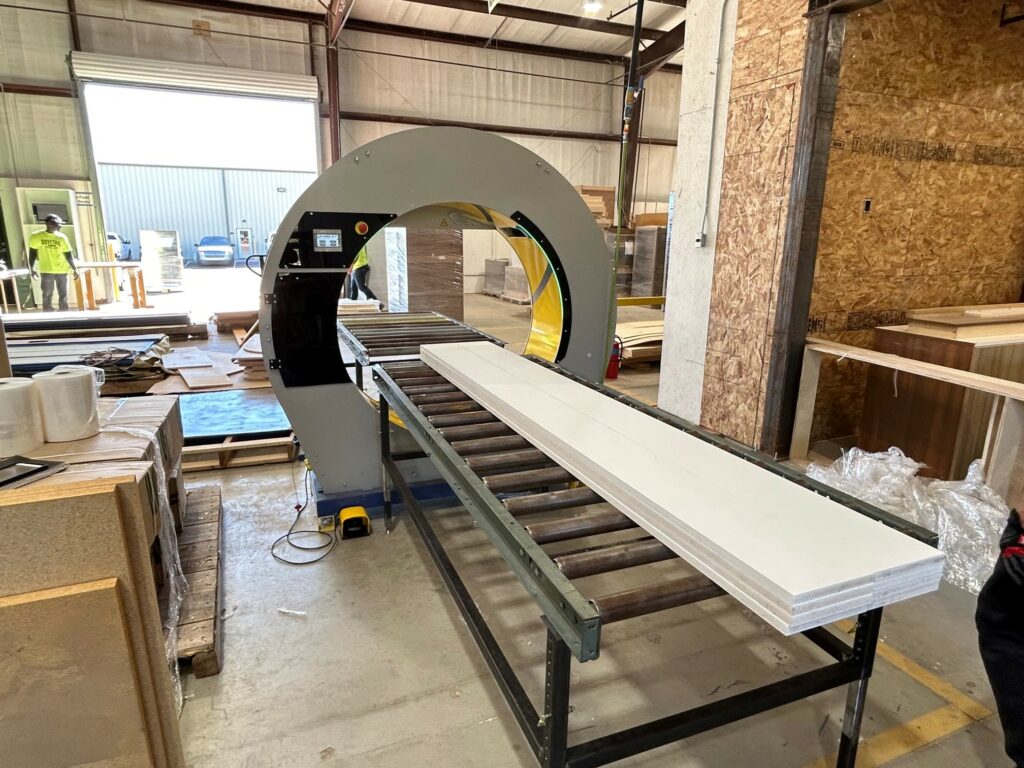
Orbital wrapping systems take a fundamentally different approach. Instead of rotating the product, the wrapper’s ring moves around it horizontally, keeping the load stable throughout the process.
This horizontal wrapping motion creates a secure, uniform “cocoon” around the product without introducing the stress points associated with vertical rotation.
Key benefits include:
- Eliminated structural strain: The product stays stationary, reducing the risk of glass breakage or frame distortion.
- Consistent containment: Tension is applied evenly across the entire surface, avoiding corner crushing.
- Improved load integrity: The final wrap stabilizes the product for transit without compromising its structure.
For manufacturers handling doors, windows, and cabinetry, this method offers a level of protection that traditional systems simply can’t match.
Building a Two-Layer Protection System
While orbital wrapping provides superior containment, the most effective packaging strategy combines it with a protective primary layer. This is where integrated bubble wrap and foam dispensing systems become essential.
Primary Layer: Surface Protection
Before stretch film is applied, a cushioning layer of bubble wrap or foam is added directly to the product. This layer:
- Shields high-gloss and finished surfaces from scratches and scuffs
- Absorbs impact during handling and transit
- Prevents friction between packaging materials and the product
By applying this layer in-line, operators ensure consistent coverage without slowing down production.
Secondary Layer: Structural Containment
Once the protective layer is in place, the orbital wrapper wraps stretch film around the product, securing everything together. This outer layer:
- Holds the protective materials firmly in place
- Prevents shifting during transport
- Adds an additional barrier against environmental exposure
Together, these two layers create a comprehensive packaging system that protects both the product’s surface quality and structural integrity.
Why Integration Matters
The real advantage comes from combining these technologies into a single, streamlined process. When bubble or foam dispensers are paired directly with an orbital wrapper:
- Packaging becomes faster and more consistent
- Operators apply materials more efficiently
- Products receive uniform protection every time
This integrated approach eliminates variability and reduces the likelihood of human error—two major contributors to shipping damage.
The Cost of Inadequate Packaging
Damage to doors, windows, and cabinetry isn’t just an inconvenience—it’s expensive. Costs can include:
- Product replacement or repair
- Return shipping and logistics
- Production delays
- Customer dissatisfaction or lost business
When viewed at scale, even a small percentage of damaged shipments can significantly impact profitability.
By investing in the right end-of-line packaging system, manufacturers can drastically reduce these risks and protect both their products and their bottom line.
Orbital Wrappers: The Best Packaging Approach for Millwork
Protecting doors, windows, and cabinetry requires more than just wrapping film around a product. It requires a packaging strategy tailored to delicate materials, finished surfaces, and complex assemblies.
By combining in-line protective dispensers with the precision and stability of orbital wrapping, manufacturers can eliminate the most common causes of shipping damage and ensure their products arrive in perfect condition.
Handle It specializes in end-of-line packaging solutions built for exactly these challenges. If you’d like to learn more about improving your packaging process, contact us today.