
How to Integrate a Fully Automatic Stretch Wrapper into an Existing Packaging Line
In modern manufacturing and distribution environments, automation becomes crucial for maintaining throughput, reducing labor costs, and improving load consistency. One of the most valuable upgrades in many cases is inserting a fully automatic stretch wrapper into your existing packaging line. But doing so isn’t just a matter of dropping in a new machine — it requires careful planning, layout, controls integration, and safety considerations.
Below is a guide to help you understand the key steps and best practices for integrating a fully automatic stretch wrapper, along with how Handle-It’s 4000-level machines (e.g., FA-4000, FA-4100, FA-4400, FA-4500) fit into these integration scenarios.

Why Upgrade to a Fully Automatic Stretch Wrapper?
Before diving into integration steps, it’s worth revisiting the benefits of fully automatic stretch wrapping:
- Labor reduction and operator safety: You remove much of the manual film handling, attaching and cutting, reducing repetitive motion or contact with knives.
- Consistency and load security: Machine-applied film tension, wrap patterns, and repeatability lead to better containment and fewer load failures.
- Throughput scaling: Automated wrappers can keep pace with high-volume conveyor systems.
- Film savings: Advanced pre-stretch systems and controlled tension can lower film usage per pallet.
- Seamless flow: When properly integrated, the wrapper becomes an invisible link in a continuous packaging chain rather than a bottleneck.
Planning Your Stretch Wrapper Integration
Before you commit to a given automatic wrapper or layout, walk through these planning steps:
Map Your Existing Line Layout and Throughput
Document conveyor speeds, pallet arrival spacing, upstream processes (like palletizing, case forming, labeling), and downstream handling (e.g., stretch hooders, conveyors, forklift staging). Identify where gaps or bottlenecks exist.]
Match Throughput and Cycle Times
The wrapper you choose must be capable of wrapping at least as many pallets per hour as your slowest upstream station (with some margin). Oversizing or undersizing the wrapper causes inefficiencies.
Understand Load Types and Stability
Some pallets are stable and symmetrical, while others may be asymmetric, tall, fragile, or irregular. That influences whether a turntable, rotary-arm, or rotary-tower design makes sense (or whether you need load-clamping features).
Conveyor Interface and Material Handling
Decide whether you will use powered roller conveyors, chain/slat conveyors, zero-pressure accumulation, or a mix. The wrapper needs to smoothly receive and release pallets without jamming or misalignment.
Control and Communication Interface
A wrapper should communicate with upstream and downstream PLCs or material flow logic. You will need sensors, triggers, safety interlocks, and possibly Ethernet or fieldbus connectivity.
Safety, Guarding, and Layout Space
Safety fencing, light curtains, emergency stops, forklift clearances, and maintenance access must all be accounted for in the footprint.
Utility and Infrastructure Requirements
Check your available electrical power (often 480V 3-phase or 230V, depending on region), compressed air, floor flatness, alignment, and structural foundations.
Step-by-Step Guide to Automating Your End-of-Line Wrapping
Here’s a recommended sequence and approach for integrating a wrapper into an existing line:
| Phase | Key Tasks | Tips & Pitfalls |
| Design & Layout | Draw the wrapper position in CAD with clearances, conveyors, infeed, and exit zones | Leave extra space for service access and future upgrades |
| Mechanical Alignment | Ensure conveyors leading into and out of the wrapper are precisely in line and leveled | Misaligned conveyors are one of the biggest sources of jams |
| Sensor & Logic Design | Add presence sensors, photo eyes, forks stops, or pallet stops to trigger the wrap cycle | Use debounce/filtering logic to avoid false triggers |
| PLC / HMI Integration | Program the wrapper’s PLC to receive “pallet arrived,” “start wrap,” “wrap complete” signals, and feed status back upstream | Use handshake signals to avoid overruns or double starts |
| Test & Tune Wrap Cycles | With test pallets, adjust tension, overlap, and film parameters | Wrap a variety of pallets (heavy, light, irregular) during commissioning |
| Safety Commissioning | Validate that guarding, light curtains, emergency stops, and safe zones conform to standards | Conduct a safety walk-through with operations staff |
| Ramp-up & Monitoring | Start with a limited run, monitor for issues or jams, then gradually increase to full production | Log cycle times, rejects, and downtime for continuous improvement |
Tip: Always establish a “fallback” bypass (manual mode) so that, in the event of wrapper downtime, pallets can circumvent the wrapper and maintain throughput.
Best Practices & Tips
From real-world installations, here are practical tips and caveats:
- Start with “average worst-case” pallets: Commission using the hardest loads (tall, unstable) rather than the easy ones.
- Allow “cycle buffer” time: Even if the wrapper can wrap in, say, 30 seconds, leave buffer time so adjacent systems do not conflict.
- Use diagnostic feedback: Choose wrappers with fault logging, diagnostics, and remote connectivity to speed troubleshooting.
- Maintain film consistency: Use consistent stretch film specs; variations (thickness, core, supplier) can throw off tension settings.
- Plan service access & spare parts: Have spare motors, belts, sensors, and film rolls ready. Design the layout so technicians have access.
- Operator training is critical: Though automatic, operators still need training on clearing faults, film threading, basic maintenance, and safety.
- Monitor data over time: Track rejects, wrap cycle durations, downtime causes — continuous improvement depends on data.
Ready to Automate Your Process? Let’s Build Your Perfect Wrapping Solution
When you bring a Handle-It 4000-level fully automatic stretch wrapper into your line, you’re doing more than adding new equipment—you’re investing in a smarter, more efficient, and future-ready warehouse.
Seamless automation doesn’t have to be complicated. Whether you’re upgrading an existing line or designing a new one, Handle-It’s team can help you identify the right fully automatic stretch wrapper and guide you through integration from layout to launch. Connect with us today to start streamlining your packaging process.
Request an AssessmentExplore Related Topics & Equipment
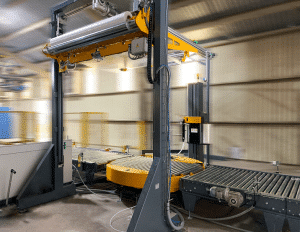
Read on to learn more about pallet wrapper pricing and the various cost savings you can expect.
Learn more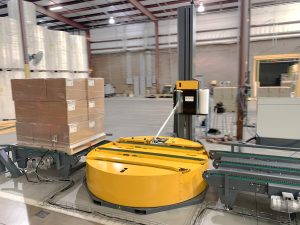
Learn more about semi and fully-automatic pallet wrappers and how to decide which one is right for you.
Learn more
The 3 reasons that show you the advantages of buying a pallet wrapping machine.
Learn more