
Bolt-On vs. Lift-Out Guard Rail Systems: What’s the Difference?
Warehouse guard rail systems are designed to protect equipment, personnel, and infrastructure from impacts caused by forklifts, pallet jacks, and other material handling equipment. While most systems follow the same basic structure—posts anchored into concrete with rails forming a protective barrier—the way those rails connect to the posts can vary significantly.
The two most common configurations are bolt-on guard rail systems and lift-out (drop-in) guard rail systems. Each offers distinct advantages depending on how your facility operates, how often layouts change, and how much access you need behind protected areas.
How Guard Rail Systems Work
At a high level, all warehouse guard rail systems follow the same foundational design:
- Steel posts are anchored into concrete flooring
- Horizontal rails connect posts to form a continuous barrier
- The system absorbs and redirects impact to protect assets and people
The key difference lies in how those rails attach to the posts, which directly affects flexibility, strength, and accessibility.
Bolt-On Guard Rail Systems
A bolt-on system secures rails to posts using pre-drilled holes and heavy-duty bolts. Once installed, the connection is rigid and highly secure.
Key Advantages
- High structural strength: Bolted connections create a very tight, stable barrier
- Lower upfront cost: Typically less expensive to manufacture and install
- Widespread availability: Common configuration across many warehouse environments
- Minimal movement or “play” in the rail system once tightened

Limitations
- Limited accessibility: Removing rails requires unbolting multiple fasteners
- Less flexibility for changing layouts: Not ideal for areas needing frequent access
- Longer modification time: Adjustments can be labor-intensive
Best Use Cases
Bolt-on systems are ideal for:
- Perimeter protection
- Long-term fixed layouts
- High-impact zones where strength is the top priority
Lift-Out Guard Rail Systems
Lift-out systems use welded slots or sleeve-style posts that allow rails to be dropped in and removed without unbolting hardware. In some configurations, lift-out adapters can also be installed on standard posts to create removable sections.
This approach allows facilities to add lift-out functionality to an otherwise fixed guard rail system, increasing flexibility without requiring a fully dedicated lift-out design.
Key Advantages
- Fast access: Rails can be removed quickly when needed
- Flexible facility design: Ideal for areas requiring periodic access
- Quicker operational adjustments: Easier to reconfigure than bolt-on systems
- Improved workflow access points: Helpful for maintenance zones or equipment entry.
Limitations
- Higher cost: Additional fabrication and welding typically increase the price
- Slightly less rigidity: Rails may have more natural movement in slots compared to bolted systems
- More specialized components: Not always as universally standardized
Best Use Cases
Lift-out systems work well in:
- Loading docks and staging areas
- Maintenance or service access zones
- Production areas requiring occasional forklift entry through barriers
- Facilities with frequently changing layouts
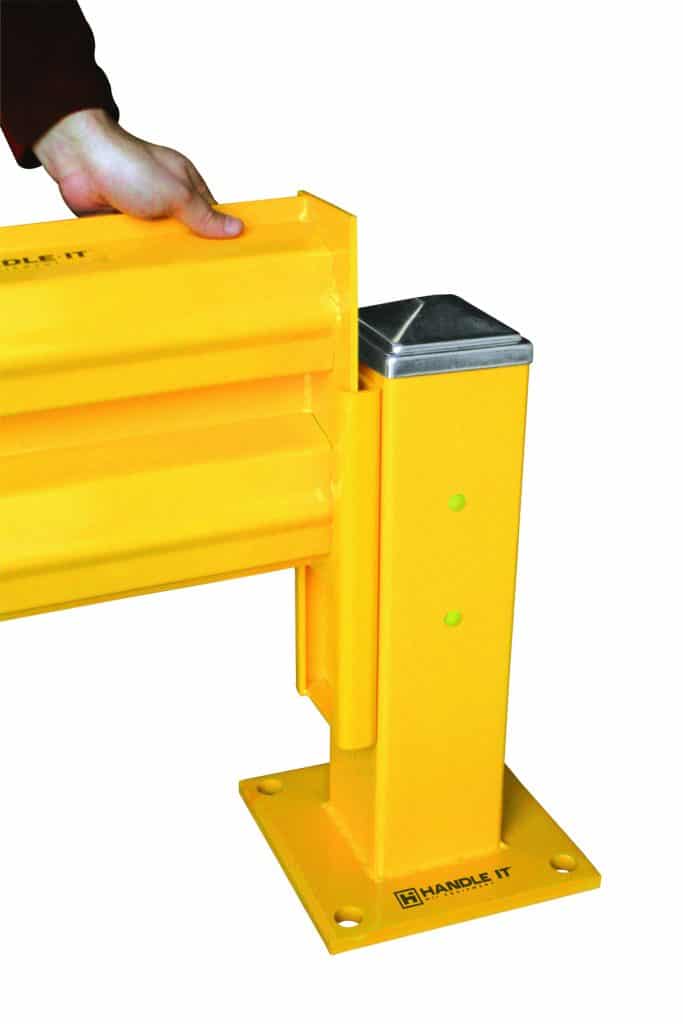
Bolt-On vs. Lift-Out Guard Rail Systems: Side-by-Side Comparison
| Feature | Bolt-On Guard Rails | Lift-Out Guard Rails |
| Strength | Very High | High |
| Cost | Lower | Higher |
| Accessibility | Limited | Excellent |
| Installation Speed | Moderate | Faster |
| Flexibility | Low | High |
| Maintenance Access | Difficult | Easy |
Hybrid Approach: The Best of Both Systems
Many facilities don’t choose just one system. Instead, they combine both approaches—for example, facilities often:
- Use bolt-on guard rails for permanent perimeter protection
- Add lift-out sections in key access points or service lanes
This hybrid approach balances durability with operational flexibility, especially in busy warehouses where layouts and traffic patterns evolve over time.
In some systems, this flexibility goes even further. Lift-out adapters can be added to existing bolt-on guard rails, allowing facilities to convert fixed sections into removable ones without replacing the entire system.
Choosing the Right Guard Rail System for Your Facility
When deciding between bolt-on and lift-out guard rail, consider:
- How often will equipment or personnel need access behind the barrier?
- Is the layout permanent or likely to change?
- Is impact resistance or flexibility more important for this area?
- What is your budget for both installation and long-term maintenance?
In many cases, the best solution is not one system over the other, but the right combination of both.
Improve Your Warehouse Protection with Handle-It Guard Rail Systems
Bolt-on and lift-out guard rail systems both serve the same core purpose: protecting people, equipment, and infrastructure in industrial environments. The real difference comes down to how much flexibility you need versus how much rigidity you want.
A bolt-on system delivers maximum strength and cost efficiency, while a lift-out system provides superior access and adaptability. Many modern facilities use both strategically to optimize safety and operational flow.
For facilities looking to design or upgrade their safety systems, Handle-It offers guard rail solutions that can be configured to match both fixed and flexible operational needs.
With features like 4-way mounting posts and bolt-on lift-out adapters, Handle-It systems can be easily customized or modified over time without requiring a full system replacement. Plus, with one of the widest networks of shipping points in the country, you get the products you need when you need them.